Schaum's Outline of Calculus, 3rd Edition (1990)
About the Book
Schaum's Outline of Theory and Problems of Differential and Integral Calculus (third edition, McGraw-Hill, 1990) is a calculus problem book, and one of the most widely used ones ever printed. Frank Ayres, Jr. wrote the original outline for the Schaum series; Elliott Mendelson reworked that text into this edition.
What kept the book alive is the format. Each of the 76 chapters compresses the theory into a page or two, then walks through a set of solved problems step by step, then hands you supplementary problems to practice alone. Every problem in the book comes with an answer: the solved ones are worked in full, and the supplementary ones have their answers printed in the book, so you can always check your work.
If your course textbook explains the ideas but leaves you short on practice, this book fixes that. It also runs the whole sequence — from absolute value and inequalities to partial derivatives, multiple integrals, and differential equations — in one 489-page volume, where modern course books usually take three.
Fast links
Book at a Glance
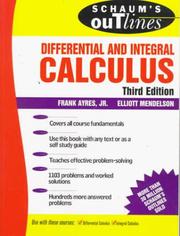
| Field | Value |
|---|---|
| Full title | Schaum's Outline of Theory and Problems of Differential and Integral Calculus |
| Cover title | Theory and Problems of Differential and Integral Calculus |
| Spine title | Calculus |
| Authors | Frank Ayres, Jr. and Elliott Mendelson |
| Publisher | McGraw-Hill, New York |
| Series | Schaum's Outline Series |
| Edition | 3rd edition |
| Year | 1990 |
| Pages | 489 |
| ISBN | 0-07-002662-9 (978-0-07-002662-9) |
| LCCN | 89013068 |
| OCLC | 45733539 |
| Language | English |
Where to Read or Download It
You won't find the 1990 printing in bookstores, but you don't need to hunt for random PDFs either. Three legal routes:
- Internet Archive: archive.org/details/schaumsoutlineof0000ayre_o1q8. A scan of this exact 1990 printing. You can read it online in the browser or borrow the e-copy with a free account, the way you'd borrow a book from a library.
- Open Library: openlibrary.org/books/OL2194107M. The catalog page for this edition, with borrow links and reader lists.
- WorldCat: search.worldcat.org/oclc/45733539. Enter your location and it shows the nearest libraries holding a physical copy.
Used print copies are another option: the 3rd edition sold in big numbers and turns up cheap on the second-hand market.
How the Book Is Organized
Every chapter follows the same three beats: a short theory block, a Solved Problems section, and a Supplementary Problems section. The solved problems carry the book — that's where you watch each technique applied — and since answers to all problems are printed in the book, the supplementary set works as a self-test. Because the theory is kept brief, the chapters line up with almost any calculus course, whatever textbook it uses.
| Part | Chapters | What it covers |
|---|---|---|
| I | 1–8 | Foundations: real numbers, absolute value, inequalities, coordinate systems, lines, circles, conics, functions, limits, continuity |
| II | 9–29 | The derivative and its applications: differentiation rules, tangents and normals, maxima and minima, related rates, trigonometric, exponential, logarithmic and hyperbolic functions, parametric curves, curvature, vectors, polar coordinates, l'Hospital's rule, curve tracing |
| III | 30–52 | Integration and its applications: substitution, parts, partial fractions, areas, volumes, centroids, moments of inertia, fluid pressure, work, arc length, surface area, improper integrals |
| IV | 53–61 | Infinite sequences and series: convergence tests, operations on series, power series, Maclaurin and Taylor formulas, computation with series, approximate integration |
| V | 62–74 | Multivariable and vector calculus: partial derivatives, space vectors, curves and surfaces, directional derivatives, divergence and curl, double and triple integrals, centroids, moments, variable density |
| VI | 75–76 | Differential equations: first-order equations and equations of order two |
Complete Table of Contents
Here is the complete table of contents of the 1990 third edition: all 76 chapters with their section titles. Section names below are descriptive rather than verbatim, and page numbers are omitted.
Part I. Foundations (Chapters 1–8)
- 1. Absolute value; Linear coordinate systems; Inequalities.
- the set of real numbers
- the absolute value
- a linear coordinate system
- finite intervals
- infinite intervals
- inequalities
- 2. The rectangular coordinate system.
- coordinate axes
- coordinates
- quadrants
- distance formula
- midpoint formulas
- proofs of geometric theorems
- 3. Lines.
- the steepness of a line
- the sign of the slope
- slope and steepness
- equations of lines
- a point-slope equation
- slope-intercept equation
- parallel lines
- perpendicular lines
- 4. Circles.
- equations of circles
- the standard equation of a circle
- 5. Equations and Their Graphs.
- the graph of an equation
- parabolas
- ellipses
- hyperbolas
- conic sections
- 6. Functions.
- function of a variable
- the graph
- 7. Limits.
- an infinite sequence
- limit of a sequence
- limit of a function
- right and left limits
- theorems of limits
- infinity
- 8. Continuity.
- a function f(x) is continuous at x₀ if
- a function f(x) is discontinuous at x₀ if
- properties of continuous functions
Part II. The Derivative and Its Applications (Chapters 9–29)
- 9. The Derivative.
- increments
- the derivative
- in finding derivatives
- differentiability
- 10. Rules for Differentiating Functions.
- differentiation
- differentiation formulas
- inverse functions
- differentiation formula for finding dy/dx given dx/dy
- composite functions; the chain rule
- alternative formulation of the chain rule
- higher derivatives
- 11. Implicit Differentiation.
- implicit functions
- derivatives of higher order
- 12. Tangents and Normals.
- the tangent and the normal to a curve
- the angle of intersection
- 13. Maximum and Minimum Values.
- increasing and decreasing functions
- relative maximum and minimum values of a function
- first-derivative test
- concavity
- a point of inflection
- second-derivative test
- 14. Applied Problems Involving Maxima and Minima.
- problems involving maxima and minima
- 15. Rectilinear and Circular Motion.
- rectilinear motion
- circular motion
- 16. Related Rates.
- related rates
- 17. Differentiation of Trigonometric Functions.
- radian measure
- trigonometric functions
- differentiation formulas
- 18. Differentiation of Inverse Trigonometric Functions.
- the inverse trigonometric functions
- differentiation formulas
- 19. Differentiation of Exponential and Logarithmic Functions.
- define the number e
- logarithmic functions
- notation
- differentiation formulas
- logarithmic differentiation
- basic properties of logarithms
- 20. Differentiation of Hyperbolic Functions.
- definitions of hyperbolic functions
- differentiation formulas
- definitions of inverse hyperbolic functions
- differentiation formulas
- 21. Parametric Representation of Curves.
- parametric equations
- the first derivative
- the second derivative
- 22. Curvature.
- derivative of arc length
- curvature
- the radius of curvature
- the circle of curvature
- the center of curvature
- the evolute
- 23. Plane Vectors.
- scalars and vectors
- sum and difference of two vectors
- components of a vector
- scalar or dot product
- scalar and vector projections
- differentiation of vectors
- 24. Curvilinear Motion.
- velocity in curvilinear motion
- acceleration in curvilinear motion
- tangential and normal components of acceleration
- 25. Polar Coordinates.
- the position of a point
- the angle between the radius vector and the tangent
- the angle of inclination
- the points of intersection
- the angle of intersection
- the derivative of arc length
- the curvature
- curvilinear motion
- 26. The Law of the Mean.
- Rolle's theorem
- the law of the mean
- generalized law of the mean
- extended law of the mean
- 27. Indeterminate Forms.
- indeterminate type 0/0; l'Hospital's rule
- indeterminate type ∞/∞
- indeterminate types 0·∞ and ∞ − ∞
- indeterminate types 00, ∞0, and 1∞
- 28. Differentials.
- differentials
- the differential dy
- approximations by differentials
- approximations of roots of equations
- 29. Curve Tracing.
- symmetry
- intercepts
- extent
- asymptotes
Part III. Integration and Its Applications (Chapters 30–52)
- 30. Fundamental Integration Formulas.
- the indefinite integral
- fundamental integration formulas
- the method of substitution
- quick integration by inspection
- 31. Integration by Parts.
- integration by parts
- reduction formulas
- 32. Trigonometric Integrals.
- trigonometric identities
- two special substitution rules
- 33. Trigonometric Substitutions.
- the trigonometric substitutions
- 34. Integration by Partial Fractions.
- a polynomial in x
- rational fractions
- case I: distinct linear factors
- case II: repeated linear factors
- case III: distinct quadratic factors
- case IV: repeated quadratic factors
- 35. Miscellaneous Substitutions.
- integrands with radicals
- the substitution x = 2 arctan z
- effective substitutions
- 36. Integration of Hyperbolic Functions.
- integration formulas
- 37. Applications of Indefinite Integrals.
- equations of curves
- the equation of motion
- 38. The Definite Integral.
- the definite integral
- properties of definite integrals
- fundamental theorem of integral calculus
- the theorem of Bliss
- 39. Plane Areas by Integration.
- area as the limit of a sum
- areas by integration
- areas between curves
- 40. Exponential and Logarithmic Functions; Exponential Growth and Decay.
- the natural logarithm
- properties of natural logarithms
- definitions
- properties of ax and ex
- derivatives and integrals involving ax and ex
- exponential growth and decay
- 41. Volumes of Solids of Revolution.
- a solid of revolution
- disc method
- washer method
- shell method
- 42. Volumes of Solids with Known Cross Sections.
- volume by cross sections
- 43. Centroids of Plane Areas and Solids of Revolution.
- the mass of a physical body
- the (first) moment of a plane area
- the (first) moment of a solid
- first theorem of Pappus
- 44. Moments of Inertia of Plane Areas and Solids of Revolution.
- the moment of inertia of a plane area
- the moment of inertia of a solid
- radius of gyration
- parallel-axis theorem
- 45. Fluid Pressure.
- pressure
- force on a submerged plane area
- 46. Work.
- constant force
- variable force
- 47. Length of Arc.
- the length of an arc
- 48. Area of a Surface of Revolution.
- the area of a surface of revolution
- 49. Centroids and Moments of Inertia of Arcs and Surfaces of Revolution.
- centroid of an arc
- second theorem of Pappus
- moments of inertia of an arc
- centroid of a surface of revolution
- moment of inertia of a surface of revolution
- 50. Plane Area and Centroid of an Area in Polar Coordinates.
- the plane area
- centroid of a plane area
- 51. Length and Centroid of an Arc and Area of a Surface of Revolution.
- the length of the arc
- centroid of an arc
- the area of the surface
- 52. Improper Integrals.
- definition
- discontinuous integrand
- infinite limits of integration
Part IV. Infinite Sequences and Series (Chapters 53–61)
- 53. Infinite Sequences and Series.
- an infinite sequence
- theorems on sequences
- infinite series
- 54. Tests for the Convergence and Divergence of Positive Series.
- series of positive terms
- 55. Series with Negative Terms.
- alternating series
- absolute convergence
- conditional convergence
- ratio test for absolute convergence
- 56. Computations with Series.
- operations on series
- addition, subtraction, and multiplication
- computations with series
- 57. Power Series.
- power series
- interval of convergence
- convergence and uniform convergence
- 58. Series Expansion of Functions.
- generating power series
- a general method for expanding a function
- 59. Maclaurin's and Taylor's Formulas with Remainders.
- Maclaurin's formula
- Taylor's formula
- series for reference
- 60. Computations Using Power Series.
- tables of logarithms
- correctness of approximations
- 61. Approximate Integration.
- an approximate value of a definite integral
- trapezoidal rule
- prismoidal formula
- Simpson's rule
- power series expansion
Part V. Multivariable and Vector Calculus (Chapters 62–74)
- 62. Partial Derivatives.
- functions of several variables
- limits and continuity
- partial derivatives
- partial derivatives of higher orders
- 63. Total Differentials and Total Derivatives.
- total differentials
- the chain rule for composite functions
- 64. Implicit Functions.
- differentiation of implicit functions
- 65. Space Vectors.
- vectors in space
- direction cosines of a vector
- vector perpendicular to two vectors
- vector product of two vectors
- triple scalar product
- triple vector product
- the straight line
- the plane
- 66. Space Curves and Surfaces.
- tangent line and normal plane to a space curve
- tangent plane and normal line to a surface
- a space curve defined by two equations
- 67. Directional Derivatives; Maximum and Minimum Values.
- directional derivatives
- relative maximum and minimum values
- 68. Vector Differentiation and Integration.
- vector differentiation
- space curves
- surfaces
- the operator ∇
- divergence and curl
- integration of vectors
- line integrals
- 69. Double and Iterated Integrals.
- the (simple) integral
- the double integral
- the iterated integral
- 70. Centroids and Moments of Inertia of Plane Areas.
- plane area by double integration
- centroids
- the moments of inertia
- 71. Volume Under a Surface by Double Integration.
- the volume under a surface
- 72. Area of a Curved Surface by Double Integration.
- the area of a curved surface
- 73. Triple Integrals.
- cylindrical and spherical coordinates
- the triple integral
- evaluation of the triple integral
- centroids and moments of inertia
- 74. Masses of Variable Density.
- homogeneous masses
Part VI. Differential Equations (Chapters 75–76)
- 75. Differential Equations.
- a differential equation
- an equation of the first order and degree
- certain differential equations
- 76. Differential Equations of Order Two.
- the second-order differential equations
Who This Book Is For
Students in a year-long calculus sequence who want more drill than their textbook offers. You read the theory, watch a technique in the solved problems, then run the supplementary set; the answers are printed in the book, so nothing stalls mid-page over a missing solution.
Self-learners, as the practice arm of a study plan. On its own the book is too terse for a first meeting with calculus. Pair it with lectures or a fuller textbook, and it does the rest.
Instructors and tutors, as a ready supply of worked examples for problem sessions. And collectors of math books: this is the mid-century Schaum's format in its polished 1990 form.
FAQ
Is Schaum's Outline of Calculus good for self-study?
As a companion, yes; as your only book, no. The theory sections run a page or two per topic, so you want a fuller source for the first contact with the ideas, and this book for drilling.
Does the book include solutions?
Every chapter has a Solved Problems section with full worked solutions, then Supplementary Problems for practice. Answers to all problems, solved and supplementary, are printed in the book itself.
Where can I legally read the 1990 third edition?
At the Internet Archive, which lets you read the scan online or borrow it with a free account, and through Open Library. WorldCat finds physical copies in libraries near you. See the links above.